Architect Magazine: Old Dominion University rewrites future of higher education
For more information, please contact:
Andrea Chin, Communications Director
Email: [email protected]
Gary McCluskie, Principal
Email: [email protected]
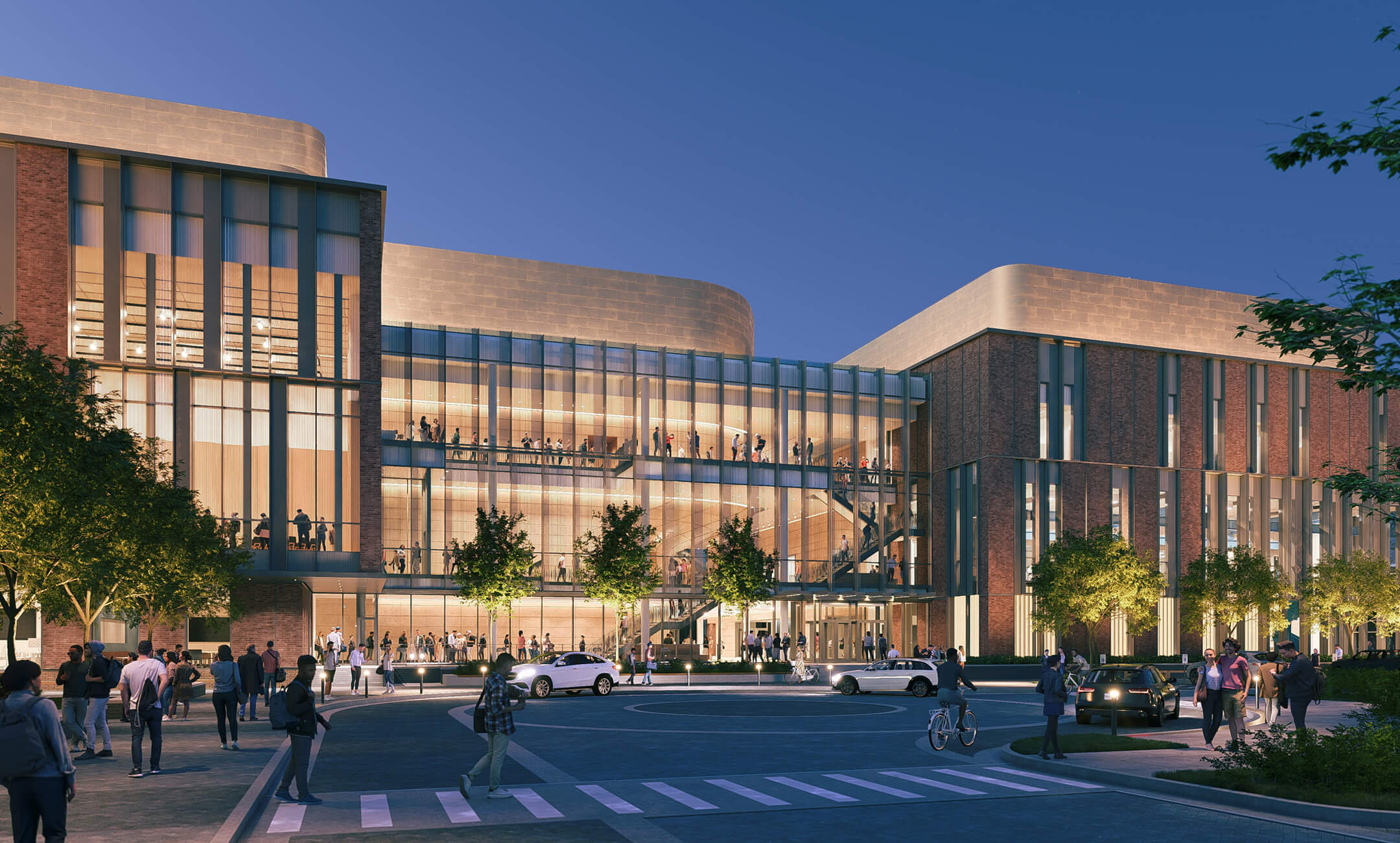
Old Dominion University's new Engineering and Arts Building has been featured in Architect Magazine in an article by Paul Makovsky.
Representing the largest capital investment in the university's history, the project reflects a broader strategy to strengthen research universities as engines of economic growth, innovation, and workforce development.
Designed by VMDO Architects (lead architect) with Ballinger (engineering) and Diamond Schmitt (arts & performance), the 141,117-square-foot facility echoes a growing belief that the future of innovation lies at the intersection of technical and creative disciplines.
Uniting the Frank Batten College of Engineering & Technology alongside the College of Arts & Letters, the building integrates advanced laboratories, design studios, fabrication spaces, galleries, performance venues, and public commons within a single academic hub capable of serving scientists and performers with equal sophistication.
The design aims to foster essential skills—such as design thinking, entrepreneurship, and interdisciplinary teamwork—naturally through daily interaction rather than formal curriculum alone. Instead of asking different fields to collaborate after the fact, the layout makes those encounters unavoidable by placing laboratories beside studios, performance venues beside research spaces, and engineering beside art.
Among its major program elements are advanced engineering labs, high-bay research areas, motion capture facilities, student design studios, fabrication spaces, galleries, and an 800-seat performance hall. Through transparent research environments, shared commons, and adaptable configurations, these visible spaces project openness—allowing students across engineering, film, performance, and architecture to share a dynamic platform envisioned to evolve over decades.
Conceived as a symbolic campus gateway and public beacon, the facility is both a campus landmark and a statement about how Old Dominion University sees its future: interdisciplinary, entrepreneurial, and deeply connected to its surrounding community and industry partners across Virginia. The project is scheduled for completion in 2030.
Read the full feature in Architect Magazine.