CBC Radio-Canada: How the Four Seasons Centre changed opera and ballet in Toronto
For more information, please contact:
Andrea Chin, Communications Director
Email: [email protected]
Matthew Lella, Principal
Email: [email protected]
On the 20th anniversary of the Four Seasons Centre for the Performing Arts, CBC Radio-Canada speaks with Principal Mathew Lella about the architectural vision behind the building—and what it continues to mean for Toronto two decades later.
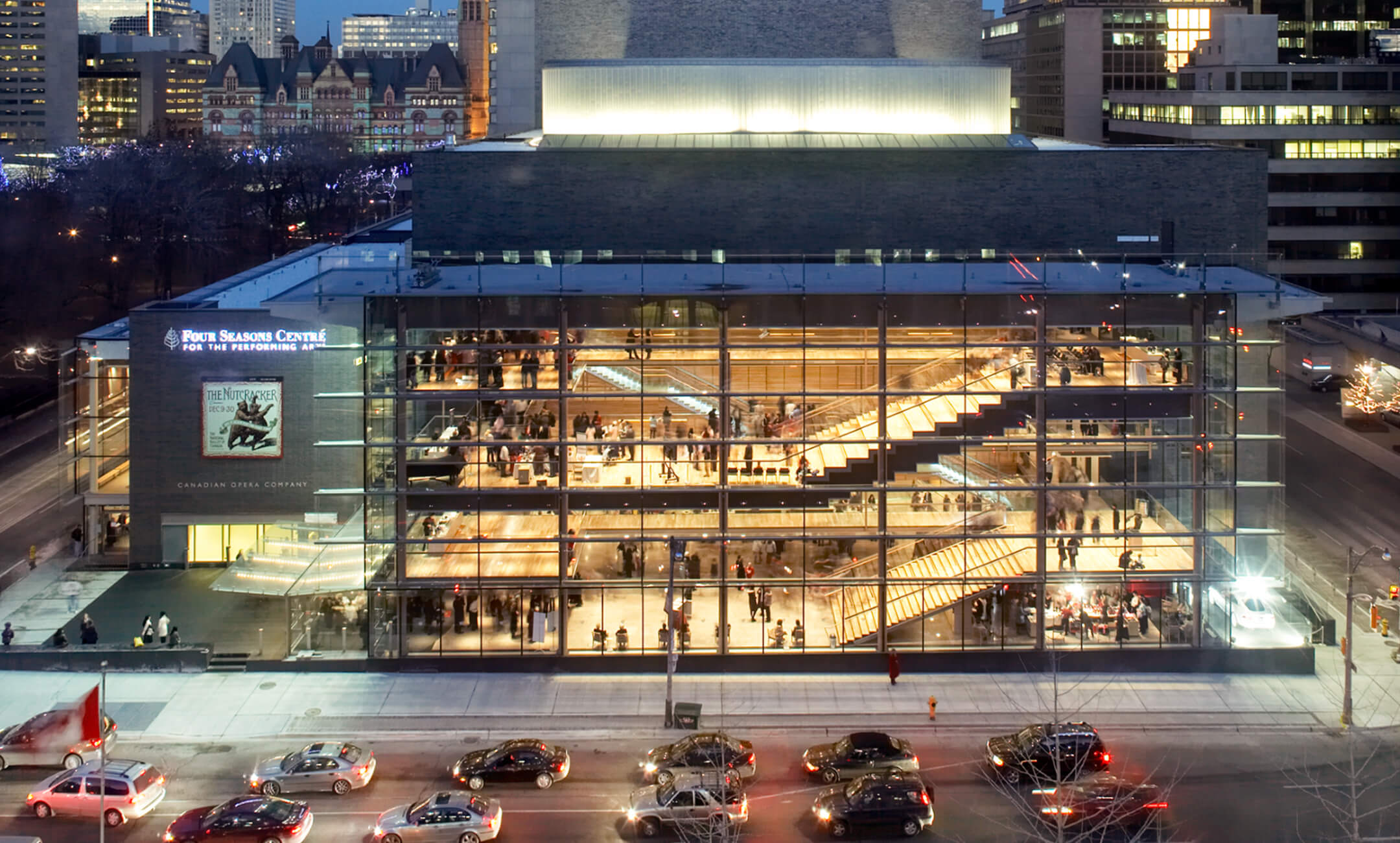
As Canada’s first purpose-built home for opera and ballet, the Centre was conceived to not only transform the experience of performance, but also to rethink the relationship between the arts and the city. At its heart, the 2,300-seat auditorium provides an acoustically and technically sophisticated home for the Canadian Opera Company and the National Ballet of Canada. Equally important is the building’s civic role. At the urban scale, along University Avenue, the four-storey City Room extends the life of the street into the building, creating a generous public threshold between the performing arts and the city.
The project emerged during a period of cultural transformation in Toronto, when several major institutions were competing for public and private support. “Everyone knew the opera house was coming, but people wondered whether it would actually happen,” Lella recalls. Even after opening, the building divided critics: the auditorium was widely praised, while the exterior prompted a more mixed response. Jack Diamond, Founding Principal and the project’s lead architect, defended his vision of integrating the building into its surrounding neighbourhood. As Lella explains, “with the AGO and the ROM nearby, there were already enough buildings vying to become icons.” Budget constraints reinforced that focus, too: “Jack wanted to make sure all the money went toward what mattered for the opera”—namely, acoustic quality.
Before the acoustics could even be addressed, Lella explains that the hall first had to be isolated from street noise—a particular challenge given that the Four Seasons Centre sits above a subway line and close to streetcar tracks. As with La Maison Symphonique in Montreal, also designed by Diamond Schmitt, the building rests on hundreds of acoustic isolation pads that separate the hall from its surrounding environment and block low-frequency vibrations. Air conditioning is also delivered quietly beneath each individual seat, with no audible hum. Together, these details produced acoustics precise enough that a performer speaking at a normal volume on stage can be heard clearly as far away as the fifth tier.
The impact extended well beyond the auditorium. Moving from the former O’Keefe Centre gave the Canadian Opera Company and the National Ballet of Canada expanded orchestra, backstage, dressing, and production spaces, fundamentally changing what they could achieve. Larger and more flexible facilities allow productions to be stored, prepared, and changed with a level of efficiency that was previously impossible.
But the truest measure of success, Mathew Lella says, is artists’ desire to return after discovering the hall—and there are many who do. The same is true of audiences, who continue to fill opera and ballet performances.
Twenty years on, the architecture continues to support the evolving needs of the Canadian Opera Company and the National Ballet of Canada while remaining deeply connected to the city around it. Through its openness, public spaces, and relationship to the street, the Centre continues to create opportunities for people to encounter the performing arts beyond the auditorium—demonstrating how architecture can shape not only how we experience performance, but how a cultural institution participates in city life.
Read the full feature on Radio-Canada.