York University Markham Campus recognized by FRAME Awards
For more information, please contact:
Andrea Chin, Communications Director
Email: [email protected]
Don Schmitt, Principal
Email: [email protected]
As part of the international FRAME Awards, York University Markham Campus has received two designations—achieving Gold status in the Learning Space category and Bronze status in the Material category.
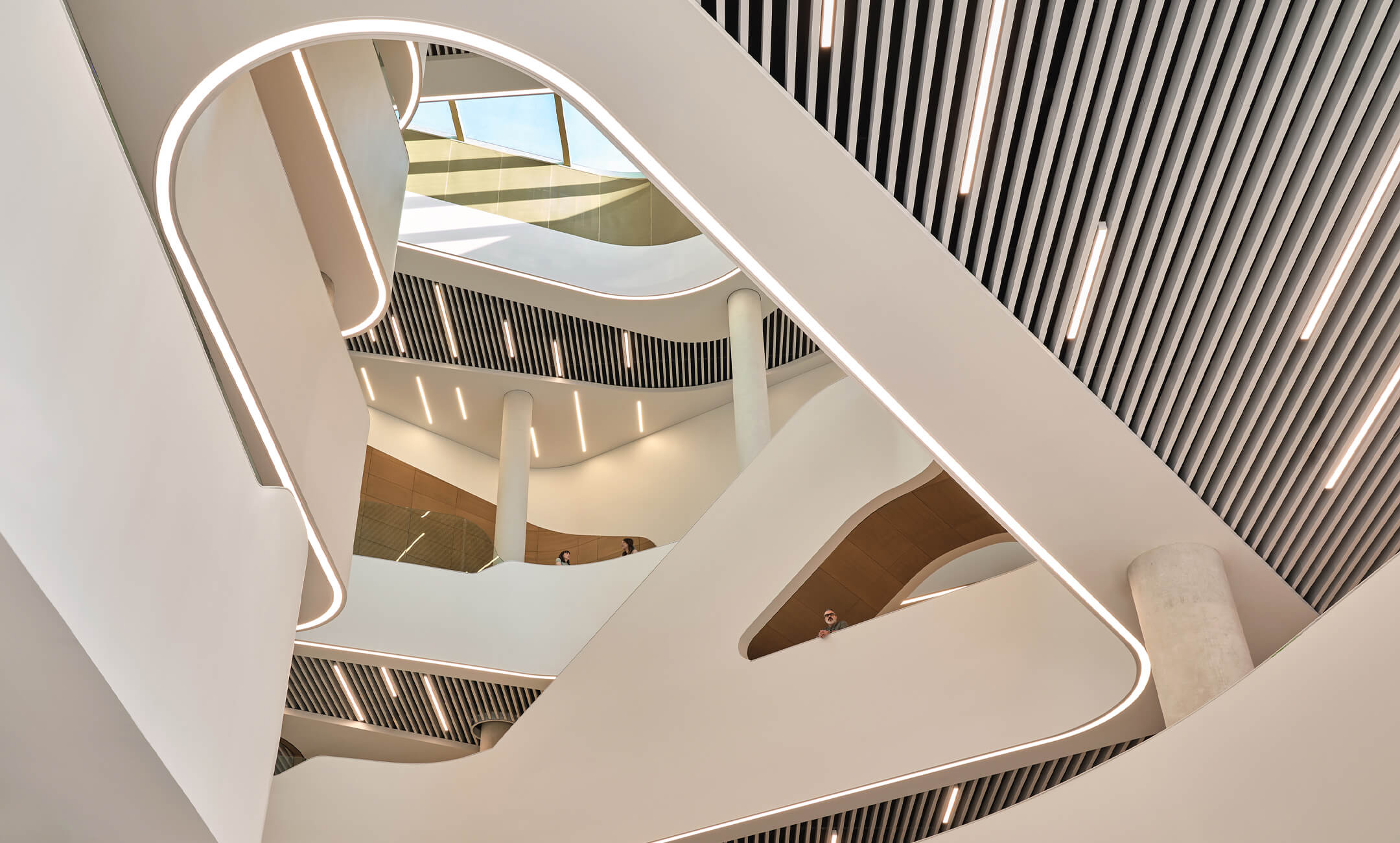
The Gold status for Learning Space acknowledges how the 400,000-square-foot building reimagines the academic building as a vertical campus, bringing teaching, student life, research, and community engagement together within a single interconnected environment. Its innovation lies in transforming density into a catalyst for collaboration, organizing diverse disciplines around a five-storey atrium—a shared social and academic heart that serves as both circulation and social infrastructure—where movement through the building becoming part of the learning experience itself. Student services, lounges, a multi-faith room, and a library occupy the lower levels, while academic neighbourhoods for diverse faculties stack above, each distinct yet connected.
The Bronze status for Material reflects the project's calibrated language and construction approach. A neutral base is animated by moments of colour for orientation and identity, while custom millwork seating and informal work zones brings warmth to daily use. Externally, bronze-coloured aluminum cladding, spandrel panels, and vision glass establish a refined architectural rhythm, with a low window-to-wall ratio supporting energy performance and strategic glazing maximizing daylight and views between the building and public realm. As a LEED Gold Certified, all-electric building constructed with sustainably sourced and recycled materials, the campus supports regional manufacturers while reducing construction waste.
The design points to what's possible when a campus is shaped around how people move, gather, and learn; where shared spaces double as social infrastructure and materiality plays as active a role as the plan itself. It's a new model for urban learning that's civic, flexible, and inclusive, demonstrating how architecture can shape academic life and community growth.
See the full project feature and jury scores on FRAME Magazine.